
For the general comparison behind this article, see AI agents vs workflow automation.
For over a decade, Robotic Process Automation (RPA) has been the go-to solution for procurement automation. But as enterprises demand more intelligent, adaptive systems, a new paradigm is emerging: Agentic AI. Understanding the fundamental differences between these approaches is critical for procurement leaders planning their automation strategy.
The Fundamental Difference: Scripts vs. Intelligence
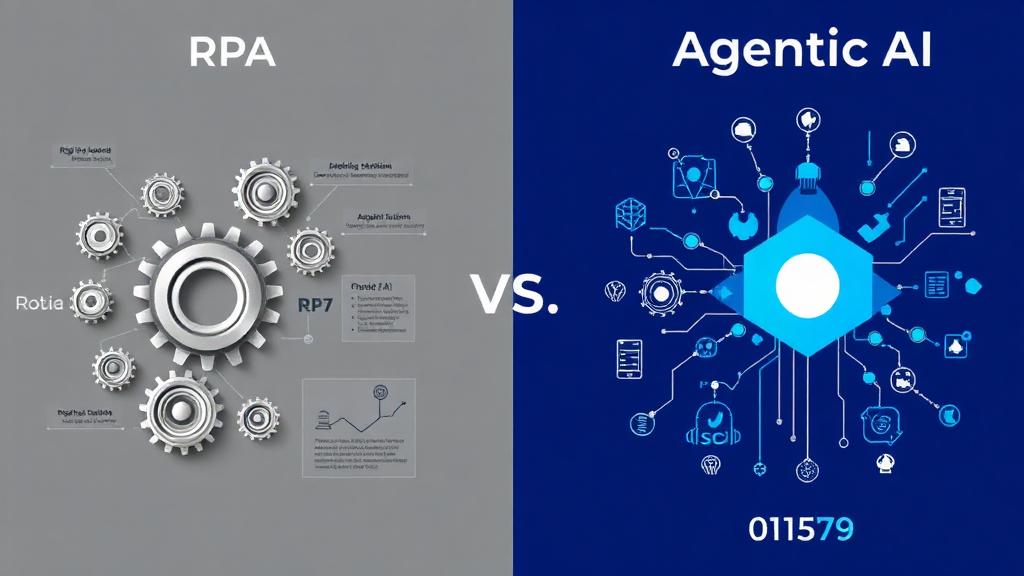
At its core, the distinction between RPA and Agentic AI comes down to one word: adaptability. RPA executes predefined scripts, it follows rules, clicks buttons, and moves data exactly as programmed. Agentic AI, by contrast, understands context, learns from outcomes, and makes autonomous decisions.
Traditional RPA
"If X happens, do Y"
- Rule-based execution
- Brittle when processes change
- Requires constant maintenance
- No learning capability
- Single-task focused
Agentic AI
"Understand the goal, figure out how"
- Context-aware decision making
- Adapts to process variations
- Self-improving over time
- Continuous learning
- Cross-functional coordination
Why RPA Falls Short in Modern Procurement
RPA delivered significant value in the early automation era by handling repetitive, rule-based tasks. But procurement has evolved. Today's challenges require systems that can handle ambiguity, learn from exceptions, and coordinate across complex supplier ecosystems.
The Maintenance Burden
The recurring cost of an RPA estate sits in maintenance rather than in the initial build. Every time a vendor portal updates its interface or an ERP system changes a field, the scripts that depended on the old layout break and have to be repaired.
The Hidden Cost of RPA Brittleness
Large RPA estates degrade as the systems they touch change. Interfaces get redesigned, fields move, formats shift, and each change breaks the scripts that depended on the old layout. Maintenance load grows with fleet size, so the larger the estate, the more of the automation team's capacity goes to repair rather than new work.
The Exception Problem
RPA handles the "happy path" well, standard invoices, typical purchase orders, routine approvals. But procurement is full of exceptions: non-standard contracts, partial deliveries, pricing discrepancies, quality issues. When exceptions occur, RPA bots either fail completely or route everything to humans, eliminating efficiency gains.
In practice, a large share of procurement transactions involve some form of exception. RPA's inability to handle these exceptions limits its real-world impact significantly.
No Cross-Process Intelligence
Traditional RPA bots operate in silos. An invoice processing bot doesn't know what the purchase order bot did. A vendor onboarding bot can't leverage insights from the contract management bot. This fragmentation prevents organizations from achieving end-to-end process optimization.
How Agentic AI Transforms the Equation
1Contextual Understanding
Agentic AI doesn't just read data, it understands meaning. When processing an invoice, an AI agent recognizes that "Net 30" and "Payment due within 30 days" mean the same thing. It understands that a small price variance on a commodity item might be acceptable, while the same variance on a contracted item requires investigation.
Result: Much higher straight-through processing rates than typical RPA achieves.
2Autonomous Decision Making
When an AI agent encounters an exception, it doesn't simply escalate to a human. It evaluates the situation, considers historical precedents, weighs organizational policies, and makes an informed decision, or presents a recommendation with clear reasoning.
Result: A significant reduction in human exception handling.
3Continuous Learning
Every transaction makes an AI agent smarter. When a human overrides an agent decision, the system learns why. When a new vendor pattern emerges, the agent adapts. This creates a virtuous cycle where automation effectiveness improves over time, the opposite of RPA's degradation curve.
Result: Steady efficiency improvement each quarter in the first year.
4Cross-Functional Orchestration
Agentic AI systems coordinate across processes naturally. A procurement agent can collaborate with finance agents, inventory agents, and compliance agents to optimize end-to-end outcomes, not just individual task completion.
Result: A notable improvement in process cycle times through intelligent coordination.
Head-to-Head Comparison: Real-World Scenarios
Scenario 1: Invoice with Pricing Discrepancy
RPA Approach
- Bot detects price doesn't match PO
- Bot routes to exception queue
- Human investigates (takes a while)
- Human approves or rejects
- Bot continues processing
Time: Tens of minutes | Human touch: Required
Agentic AI Approach
- Agent detects price variance
- Checks if within tolerance for this category
- Reviews contract terms and market prices
- Considers vendor history and relationship
- Auto-approves or escalates with full context
Time: Seconds | Human touch: Rarely required
Scenario 2: New Vendor Onboarding
RPA Approach
- Extract data from forms (if format matches)
- Input into ERP (if fields align)
- Send templated emails
- Manual risk assessment required
- Manual compliance verification
Time: Multiple days | Failure rate: High
Agentic AI Approach
- Understands any document format
- Auto-generates risk assessment
- Verifies compliance autonomously
- Negotiates terms if authorized
- Coordinates across finance/legal/procurement
Time: Same day | Success rate: High
The Business Case: RPA vs Agentic AI ROI
| Metric | Traditional RPA | Agentic AI |
|---|---|---|
| Implementation Time | Long | Short |
| Straight-Through Processing | Moderate | High |
| Annual Maintenance Cost | Significant share of initial investment | Small share of initial investment |
| Exception Handling | Manual escalation | Autonomous resolution |
| Adaptability | Requires reprogramming | Self-learning |
| 3-Year TCO | Higher multiple of initial cost | Lower multiple of initial cost |
When RPA Still Makes Sense
Despite Agentic AI's advantages, RPA remains appropriate for certain scenarios:
- Highly stable processes with zero variation (rare in procurement)
- Simple data transfers between systems with fixed formats
- Legacy systems with limited API access where screen scraping is the only option
- Regulatory requirements mandating exact, auditable process steps
However, even in these cases, organizations increasingly deploy RPA as a tactical layer beneath Agentic AI orchestration, using bots for execution while agents handle decision-making.
The Migration Path: From RPA to Agentic AI
Organizations don't need to abandon existing RPA investments. The most successful approach treats RPA as a stepping stone:
Phase 1: Assess Current State
Evaluate existing RPA bots, identify high-maintenance automations, and map processes with high exception rates, these are prime candidates for Agentic AI migration.
Phase 2: Layer Intelligence
Deploy AI agents that orchestrate existing RPA bots, adding decision-making capability on top of execution. This preserves RPA investment while adding intelligence.
Phase 3: Replace High-Friction Bots
Migrate the most problematic RPA automations to native Agentic AI, prioritizing processes with high maintenance costs or poor exception handling.
Phase 4: Expand Agentic Capabilities
As agents prove value, expand their scope to include cross-functional coordination, predictive intelligence, and autonomous decision-making across the full Procurement lifecycle.
The Verdict: Evolution, Not Revolution
The shift from RPA to Agentic AI isn't about discarding the past, it's about evolving toward truly intelligent automation. RPA was the right solution for its time, automating tasks that were too tedious for humans but too simple for sophisticated AI.
Today, procurement demands more. The complexity of global supply chains, the pace of business change, and the volume of exceptions require systems that think, learn, and adapt. Agentic AI delivers these capabilities while offering superior ROI, lower maintenance costs, and continuous improvement.
The Bottom Line
Enterprises are steadily moving from rule-based bots to agents that reason over exceptions. The question isn't whether this shift will happen, but whether your organization will lead or follow. Those who embrace intelligent automation now will build capabilities that compound over time, creating advantages that late adopters will struggle to overcome.
Ready to evolve beyond RPA? VeroTX's Agentic AI platform delivers the intelligence, adaptability, and cross-functional coordination that modern procurement demands, without the maintenance burden of traditional automation.
See the before and after
Go beyond RPA and copilots. See how VeroTX replaces fragmented tools with a single AI-native execution layer.
See the transformation