
The Hidden Costs of Procure-to-Pay: How 7 Handoff Points Silently Drain Your Margins
Most CFOs know procurement is expensive. Few realize exactly where the money disappears. It's not one catastrophic failure, it's a slow, compounding bleed across every handoff in the procure-to-pay lifecycle.
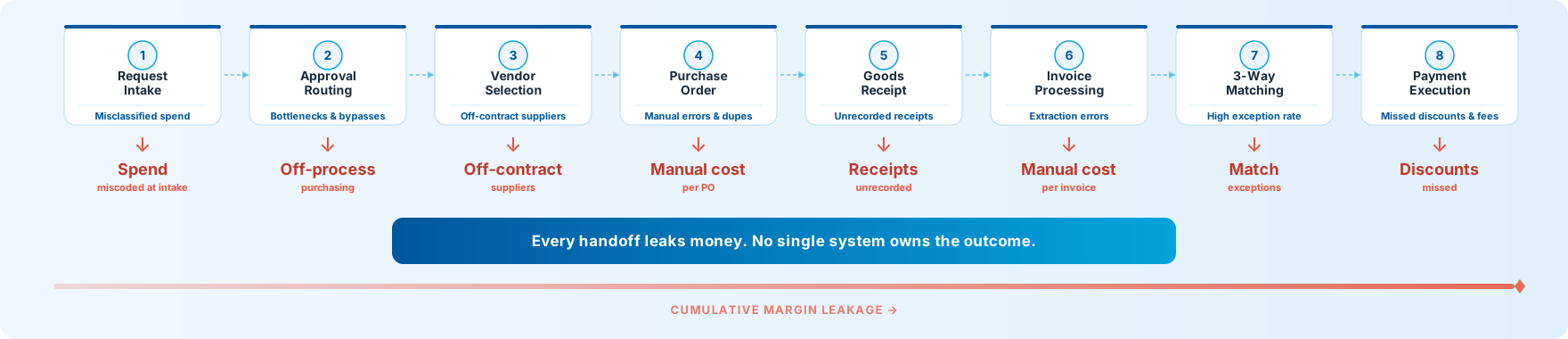
We mapped the seven critical touchpoints in a typical Procurement process and found that cumulative margin leakage across them is the norm, not the exception. It is a slow, compounding bleed that most finance leaders never quantify because no single handoff looks catastrophic on its own.
The 7 Handoff Points Where Money Disappears
1. Request Intake: Misclassified Spend
The procurement lifecycle begins with a request, and the problems start immediately. When requests arrive via email, spreadsheets, or ad-hoc messages, classification accuracy plummets. Misclassified spend means:
- Wrong approval chains are triggered, causing delays or rubber-stamping
- Spend data is polluted from day one, undermining downstream analytics
- Policy violations go undetected because the system doesn't know what it's looking at
Typical cost: manual environments see a meaningful share of requests misclassified, which drives elevated rework rates.
2. Sourcing: Suboptimal Vendor Selection
Without structured vendor scoring and market intelligence, sourcing decisions default to familiarity rather than value. This means:
- Incumbent bias inflates costs relative to competitive alternatives
- Qualification gaps allow risky vendors into the supply base
- No price benchmarking means your team negotiates blind
Typical cost: organizations without AI-assisted sourcing routinely overpay on non-strategic categories.
3. PO Creation: Data Entry Errors
Purchase order creation is one of the most error-prone steps in Procurement. Manual data entry introduces:
- Quantity and pricing mismatches that cascade into invoice exceptions
- Wrong GL codes that distort financial reporting
- Missing terms that weaken contractual protections
Typical cost: a small but persistent share of POs contain material errors that require manual correction.
4. Receiving: Confirmation Delays
When goods or services are received but not promptly confirmed in the system, the entire downstream process stalls:
- Three-way matching can't proceed, blocking invoice processing
- Early-pay discounts expire while receipts sit unrecorded
- Inventory records diverge from physical reality
Typical cost: receipt confirmation delays routinely cause mid-market companies to miss early-pay discount windows entirely.
5. Invoice Processing: Exception Overload
This is where the cost crisis becomes most visible. Industry benchmarks tell a stark story:
Exception handling, price variances, quantity mismatches, missing POs, consumes the bulk of AP team bandwidth. Each exception is costly to resolve manually, and mid-market companies process a high volume of them every month.
6. Payment Execution: Missed Optimization Windows
Payment is about more than sending money. It's about when and how you send it. Manual payment processes miss:
- Early-pay discount windows (standard early-payment terms represent a strong annualized return when captured)
- Payment method optimization (ACH vs. wire vs. virtual card rebates)
- Cash flow timing that preserves working capital
Typical cost: mid-market companies typically capture only a minority of available early-pay discounts, leaving meaningful value on the table annually.
7. Close-Out & Reconciliation: The Audit Tax
The final handoff, reconciling payments, closing POs, and generating audit trails, is where manual processes exact their last toll:
- Unreconciled transactions require end-of-period fire drills
- Audit preparation consumes significant dedicated staff time each year
- Compliance gaps create regulatory exposure
Typical cost: reconciliation labor and audit preparation represent a recurring, sizable annual cost for mid-market organizations.
The Compounding Effect: Why It's Worse Than You Think
These costs don't exist in isolation, they compound. A misclassified request at intake triggers wrong approvals, leads to an incorrect PO, causes an invoice exception, delays payment past discount windows, and creates a reconciliation headache at close-out.
The Compounding Math
Each touchpoint adds hidden cost through errors, delays, and missed opportunities.
Across seven handoffs, the compounded leakage reaches a meaningful share of total addressable spend, a figure most organizations never measure because no single handoff looks catastrophic.
How AI-Native Orchestration Eliminates the Leakage
The solution isn't better tools at individual handoff points, it's eliminating the handoffs entirely. This is the fundamental architectural difference between legacy Procurement automation and AI-native orchestration.
Zero-Handoff Architecture
In an AI-native Procurement system like VeroTX, specialized agents own each stage end-to-end, passing structured, validated data between stages automatically. There is no re-keying, no email forwarding, no spreadsheet handoff. Every transition is orchestrated, validated, and tracked.
Real-Time Policy Enforcement
Instead of catching policy violations after the fact, AI agents enforce compliance at the moment of decision. Every transaction is checked against your rules before it moves forward, not reviewed in a monthly audit.
Automatic Discount Capture
Payment agents continuously monitor discount windows and optimize payment timing across your entire payable portfolio. The result: organizations using AI-native payment orchestration capture a far higher share of available early-pay discounts than manual environments, where discount windows are routinely missed.
Continuous Anomaly Detection
Rather than waiting for month-end reporting to spot problems, AI agents monitor every transaction in real-time. Spend anomalies, duplicate invoices, and contract leakage are flagged and escalated within minutes, not weeks.
The Business Case: What Elimination Looks Like
For a mid-market company processing 50,000 invoices annually with $100M in spend, the math is straightforward:
- Invoice processing savings: a substantial annual reduction in per-invoice cost as processing moves from manual to automated
- Discount capture recovery: meaningfully higher early-pay discount capture
- FTE redeployment: staff redirected from transactional processing to strategic work
- Compliance cost reduction: lower annual spend on audit preparation and reconciliation labor
Total impact: significant recovered margin, from a single process transformation.
Getting Started: The 4-Week Assessment
You don't need to overhaul everything at once. Start with a focused assessment:
- Week 1: Map your current handoff points and measure time-to-completion at each stage
- Week 2: Quantify exception rates and manual intervention costs at each touchpoint
- Week 3: Calculate your discount capture rate and missed optimization opportunities
- Week 4: Build the business case with your CFO using actual data, not industry averages
The organizations that act on this analysis, replacing fragile handoffs with AI-native orchestration, aren't just cutting costs. They're building a structural advantage that compounds every quarter.
Stop the Leakage. See VeroTX in Action.
Explore how our AI-native Procurement platform eliminates every handoff point, replacing fragmented tools with unified, autonomous orchestration.
See How We Eliminate Handoff Leakage →See How Procurement Eliminates Procurement Margin Leakage
Explore our execution layer for Procure-to-Pay, from intake to payment, every handoff is automated.
Explore Procurement Automation