For the general explanation of how enterprises move AI agents from pilot into production, see deploying AI agents in production.
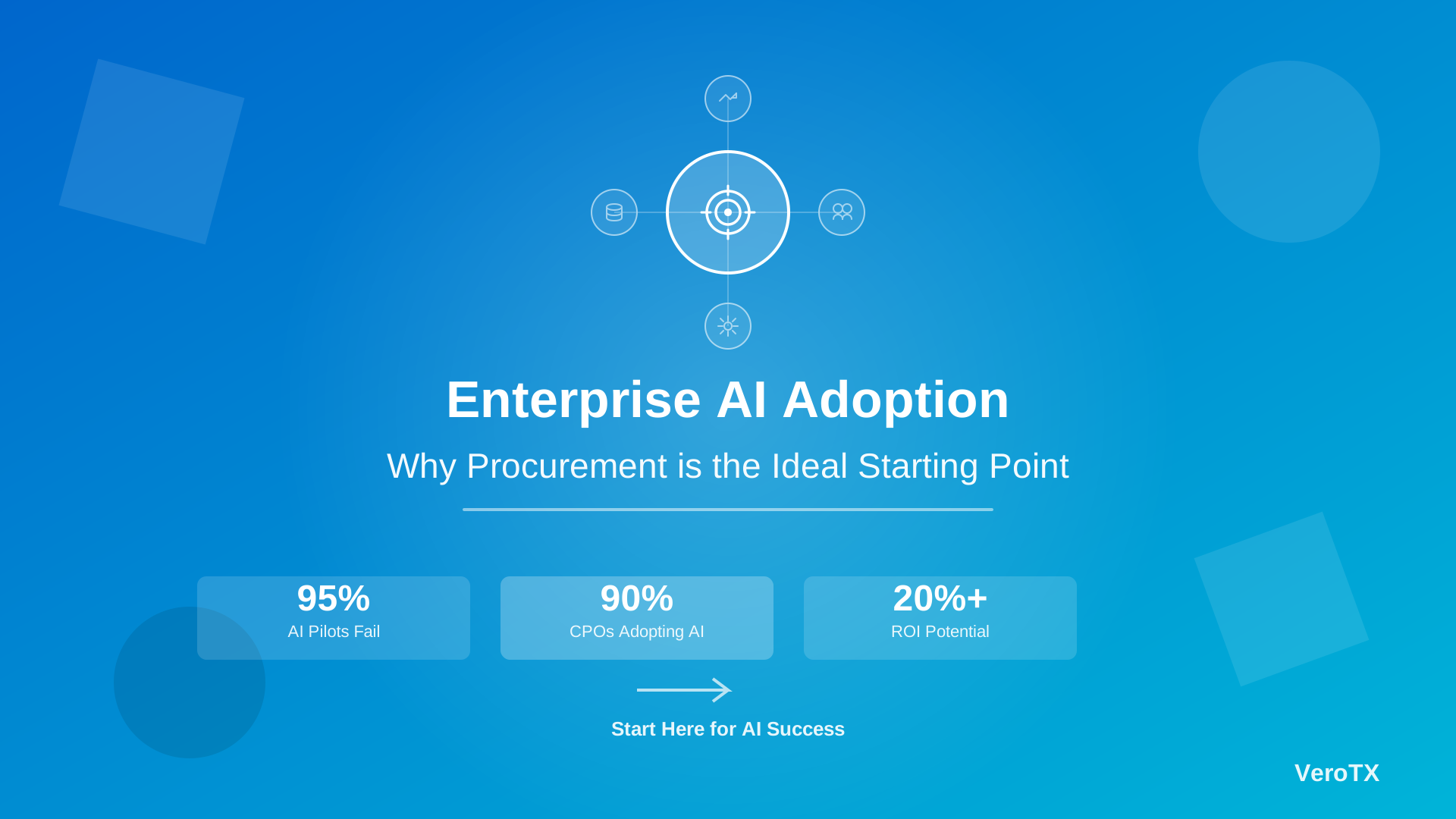
The Enterprise AI Paradox: Despite massive sums invested in generative AI, the vast majority of enterprise pilots deliver no measurable ROI, and only a small fraction of AI initiatives reach mature production adoption. Organizations face a critical question: How do you successfully launch enterprise AI transformation when most efforts fail? The answer lies not in which AI technology to deploy, but where to deploy it first. Procurement has emerged as the ideal starting point, and the data proves why.
The Enterprise AI Crisis: Why Most Initiatives Fail
The gap between AI promise and reality has become stark. Piloting generative AI is now common in large enterprises; running it in production at scale is not. Companies invest heavily in AI initiatives, yet struggle to move beyond proof-of-concept demonstrations.
Few AI initiatives deliver the ROI expected of them, and fewer still are scaled across the enterprise. Adoption also strains the organization itself, surfacing power struggles, departmental conflicts, and unclear ownership.
The Seven Critical Barriers to Enterprise AI Adoption
Poor Data Quality & Accessibility
Organizations discover their data exists in silos, incompatible formats, and varying quality levels. Data readiness is routinely the first obstacle an AI programme hits. AI systems require clean, consistent, accessible data, not scattered spreadsheets and disconnected databases.
Legacy System Integration
Most enterprises operate on decades-old infrastructure that wasn't designed for AI. Integration complexity creates technical debt, cost overruns, and implementation delays. Many organizations cite legacy integration as a primary challenge for AI deployment.
Skills & Talent Shortage
Organizations lack the specialized expertise needed for AI implementation. Data scientists, ML engineers, and AI architects are expensive and scarce. Building internal capabilities takes years, while external consultants create vendor dependence.
Unclear ROI & Business Value
Without well-defined applications, leaders struggle to justify AI investments. Usage-based pricing models create disconnection between costs and value. Projects start as "low-hanging fruit" but fail to demonstrate compelling business cases for scaling.
Lack of Clear AI Strategy
Organizations without formal AI strategies report much lower success rates than those with strategies. Without clear direction, AI initiatives become scattered experiments rather than coordinated transformation efforts.
Governance, Risk & Compliance
Questions of data privacy, security, regulatory compliance, and ethical AI usage have moved from IT concerns to board-level priorities. Organizations struggle to establish appropriate governance frameworks before deploying AI at scale.
Organizational Resistance
Cultural barriers, departmental silos, and fear of displacement create resistance. A majority of executives report friction between IT and other departments. Change management failures doom technically sound AI initiatives.
Failure to Scale Beyond Pilots
Only a small fraction of Gen AI POCs transition to production. What works in controlled pilot environments breaks down when scaled across diverse business units, geographies, and use cases.
The Core Problem: Organizations approach AI adoption by starting with the technology and searching for applications. This backward approach leads to impressive demos that fail to deliver business value. Successful AI transformation requires the opposite: start with business processes that are AI-ready, then deploy technology that solves real problems with measurable impact.
Why Procurement is the Ideal Starting Point
Procurement represents a unique convergence of characteristics that make it the perfect launchpad for enterprise AI transformation. While other functions struggle with the barriers outlined above, procurement naturally sidesteps many of them while delivering rapid, measurable results that build momentum for broader AI adoption.
"Procurement is uniquely positioned to close the gap between AI promise and reality. Think about it, procurement as a function is supposed to be the gate opener to the rest of the world. We use supply markets to shape the future of the business. And what more important market is there to shape now than the AI market itself?", Industry Analysis, Zip HQ
Ten Strategic Advantages That Make Procurement AI-Ready
1. Well-Structured, Repetitive Processes
Procurement follows standardized workflows that are documented, repeatable, and measurable. Purchase requisitions, approvals, PO creation, invoice processing, these are exactly the type of structured processes where AI delivers immediate value.
2. High-Quality, Accessible Data
Procurement generates structured data: POs, invoices, contracts, spend records, supplier information. This data already exists in relatively clean, standardized formats across ERP and Procurement systems.
3. Clear, Measurable Outcomes
Procurement success is quantifiable: processing time, cost savings, contract compliance, supplier performance, error rates. AI impact is immediately visible and objectively measurable, making it easy to demonstrate ROI.
4. Immediate Pain Points & Quick Wins
Procurement teams feel overwhelmed by manual work: data entry, approval routing, invoice matching, spend analysis. These pain points are severe, widely acknowledged, and solvable by AI.
5. Direct Cost Impact
Procurement directly controls a majority share of organizational spend. Even small efficiency gains or savings translate to significant financial impact given the scale of spend involved.
6. Existing System Integration
Modern procurement platforms are designed to integrate with ERPs, finance systems, and supplier networks. These integration points already exist, reducing the technical complexity.
7. Cross-Functional Visibility
Procurement touches every department: operations needs equipment, marketing needs services, IT needs software. Success in procurement demonstrates AI value across the entire organization.
8. Manageable Risk Profile
Unlike customer-facing AI that risks brand damage, or financial AI that creates regulatory exposure, procurement AI operates internally with clear approval workflows. Mistakes are caught before they impact customers or compliance.
9. Change Management Receptivity
Procurement teams actively seek relief from administrative burden. Unlike functions where AI feels threatening, procurement professionals view automation as liberation, freeing them for strategic work.
10. Foundation for Enterprise AI
Success in procurement establishes patterns, frameworks, and capabilities that scale across the enterprise. The learnings, infrastructure, and organizational buy-in created in procurement accelerate AI adoption everywhere else.
Procurement vs. Other Functions: A Comparative Analysis
Understanding why procurement outperforms other functions as an AI starting point becomes clear when comparing key characteristics:
| Dimension | Procurement | Sales | People Ops | Finance |
|---|---|---|---|---|
| Process Structure | Highly standardized, repeatable workflows | Variable, relationship-dependent | Mix of structured and unstructured | Structured but complex regulations |
| Data Quality | Clean, structured data in existing systems | Scattered across CRM, email, conversations | Sensitive, privacy-constrained, fragmented | High quality but regulatory restrictions |
| Measurability | Direct cost impact, clear KPIs | Attribution challenges, long cycles | Soft metrics, hard to quantify | Measurable but compliance-heavy |
| Risk Profile | Internal process, contained errors | High - direct customer impact | High - employment law, discrimination risk | Very high - regulatory and audit risk |
| Change Resistance | Teams seek automation relief | High - threatens relationships | Very high - trust and privacy concerns | Moderate - risk aversion |
| Integration Complexity | Established APIs and connectors | Complex - multiple touchpoints | Complex - legacy HRIS systems | Complex - core financial systems |
| Immediate Pain Points | Severe, universally acknowledged | Moderate - quota pressure | Moderate - capacity constraints | Moderate - period close pressure |
| Cross-Functional Impact | Touches every department | Limited to revenue functions | All employees but sensitive | Significant but specialized |
How Procurement AI Success Enables Enterprise-Wide Transformation
Starting with procurement doesn't mean stopping there, it means building a foundation for comprehensive AI transformation. Success in procurement creates cascading benefits that accelerate adoption across the enterprise.
The Procurement-Led Transformation Flywheel
From Procurement AI to Enterprise AI Excellence
How procurement success creates momentum for organization-wide AI adoption:
Phase 1: Prove Value
Deploy procurement AI: Start with high-impact use cases like invoice processing or approval routing. Deliver measurable ROI quickly. Build organizational confidence in AI capabilities.
Phase 2: Build Capabilities
Develop expertise: Teams learn AI implementation, change management, and optimization. Establish governance frameworks. Create reusable integration patterns and best practices.
Phase 3: Demonstrate Impact
Show tangible results: Cost savings, efficiency gains, and compliance improvements create executive champions. Success stories overcome skepticism in other departments.
Phase 4: Scale Horizontally
Expand to related functions: Finance sees AP automation potential. Operations recognizes inventory optimization opportunities. People Ops explores employee service automation.
Phase 5: Integrate Vertically
Connect across workflows: Procurement AI agents coordinate with finance, operations, and supply chain agents. Create end-to-end autonomous processes that span functions.
Phase 6: Achieve Transformation
Enterprise AI maturity: Organization-wide AI operating model. Continuous innovation culture. Competitive advantage through intelligent automation at scale.
Strategic Benefits Beyond Procurement
How Procurement AI Creates Enterprise-Wide Value
Executive Buy-In: CFOs and CEOs see clear financial returns, making it easier to fund AI initiatives in other areas
Change Management Blueprint: Lessons learned in procurement create playbooks for managing resistance and driving adoption elsewhere
Technical Infrastructure: Integrations, data pipelines, and governance frameworks built for procurement become reusable assets
Talent Development: Teams gain practical AI experience, creating internal expertise to support broader initiatives
Vendor Relationships: Procurement's AI vendor evaluation capabilities help IT select enterprise AI platforms
Cultural Shift: Early success creates "art of the possible" awareness that overcomes fear and resistance
Process Optimization: AI forces documentation and standardization that benefits non-AI improvement efforts
Strategic Capacity: Freed from transactional work, procurement can drive innovation, becoming change agents for transformation
Practical Roadmap: Launching Enterprise AI Through Procurement
Organizations ready to launch AI transformation through procurement should follow a structured approach that maximizes success probability while minimizing risk:
Your Procurement AI Launch Plan
This phased approach delivers immediate value while building the foundation for enterprise-wide AI adoption:
Assessment & Strategy
Identify pain points, evaluate current processes, assess data quality, define success metrics, secure executive sponsorship, establish cross-functional team
Platform Selection
Evaluate AI-powered procurement solutions, prioritize no-code platforms that avoid vendor lock-in, ensure integration with existing systems, validate security and compliance
Quick Win Pilot
Start with invoice processing or approval routing, deploy in contained environment, train core user group, measure results rigorously, gather feedback continuously
Prove ROI
Document cost savings and efficiency gains, create executive dashboard, develop success stories, present business case for scaling, celebrate and communicate wins
Scale in Procurement
Expand to additional use cases, roll out across departments, optimize based on learnings, establish governance and best practices, build internal expertise
Enterprise Expansion
Share learnings with other functions, identify next AI opportunities, establish CoE for enterprise AI, develop enterprise AI strategy, drive cultural transformation
Critical Success Factors
Start Small, Think Big
Begin with specific, contained use cases that deliver clear value. But design with enterprise scalability in mind from day one. Avoid creating technical debt through quick fixes.
Measure Everything
Track KPIs religiously: processing time, error rates, cost savings, user satisfaction, adoption rates. Data-driven storytelling builds momentum and justifies investment.
Prioritize Change Management
Technology is the easy part, people are hard. Invest heavily in communication, training, and support. Make AI a helper, not a threat. Celebrate wins publicly.
Choose Platforms, Not Point Solutions
Avoid vendor lock-in with single-purpose tools. Select no-code platforms that enable continuous evolution, easy customization, and integration across the enterprise.
Build for the Future
Today's invoice processing agent becomes tomorrow's autonomous negotiation agent. Design architectures that support increasing AI sophistication and cross-functional orchestration.
Create Internal Champions
Identify procurement team members who embrace AI. Give them resources, recognition, and platform to evangelize. Their enthusiasm becomes infectious across the organization.
The VeroTX Advantage: Purpose-Built for Procurement AI Success
VeroTX understands that procurement isn't just a good starting point for AI, it's THE starting point. Our platform is specifically designed to address the challenges that cause AI initiatives to fail, while leveraging procurement's natural advantages.
Why VeroTX Succeeds Where Others Fail
No-Code Deployment
Eliminates skills shortage barrier. Procurement professionals configure agents and workflows without IT dependencies. Deploy quickly.
Pre-Built Integration
Solves legacy system challenge. Connects seamlessly to ERP, finance, and supplier systems through pre-built connectors and open APIs.
Rapid ROI Realization
Addresses business case problem. Production deployment in 4-8 weeks with measurable ROI early on through immediate cost savings.
Agentic AI Foundation
Built for the future of autonomous agents. Not just automation, intelligent systems that learn, adapt, and collaborate across functions.
Enterprise Scalability
Overcomes pilot-to-production barrier. Start with procurement, scale across finance, operations, supply chain without rebuilding infrastructure.
Built-In Governance
Addresses risk and compliance concerns. Comprehensive audit trails, approval workflows, and security controls built into the platform.
Conclusion: The Strategic Imperative
The enterprise AI landscape is littered with failed pilots, stranded POCs, and expensive initiatives that never delivered value. Organizations that succeed share a common pattern: they start with business processes that are AI-ready, deliver quick wins that build momentum, and scale strategically from proven foundations.
Procurement represents the ideal convergence of these success factors. It offers structured processes, quality data, clear metrics, manageable risk, and immediate pain points that AI can solve. It is also where the work is structured enough for an agent to act inside defined thresholds, and where every action can be recorded against the Playbook version that produced it.
But the true value of starting with procurement extends far beyond procurement itself. Success creates executive champions, builds technical capabilities, develops change management expertise, and establishes governance frameworks that enable enterprise-wide transformation. Procurement becomes the proving ground that de-risks AI investment and accelerates adoption across all functions.
The Window is Closing: First-movers in procurement AI are already establishing competitive advantages that will compound over time. They're capturing cost savings, strengthening supplier relationships, and building organizational capabilities while competitors remain paralyzed by AI adoption challenges. The question isn't whether to start with procurement, it's whether you can afford to wait while others race ahead.
Ready to launch your enterprise AI transformation through procurement? Start where success is most achievable, then scale what works. The future belongs to organizations that act now.
Enterprise-Grade AI for Procurement
Purpose-built for mid-market and enterprise procurement teams, with governance, security, and scalability baked in.
See Enterprise Capabilities