
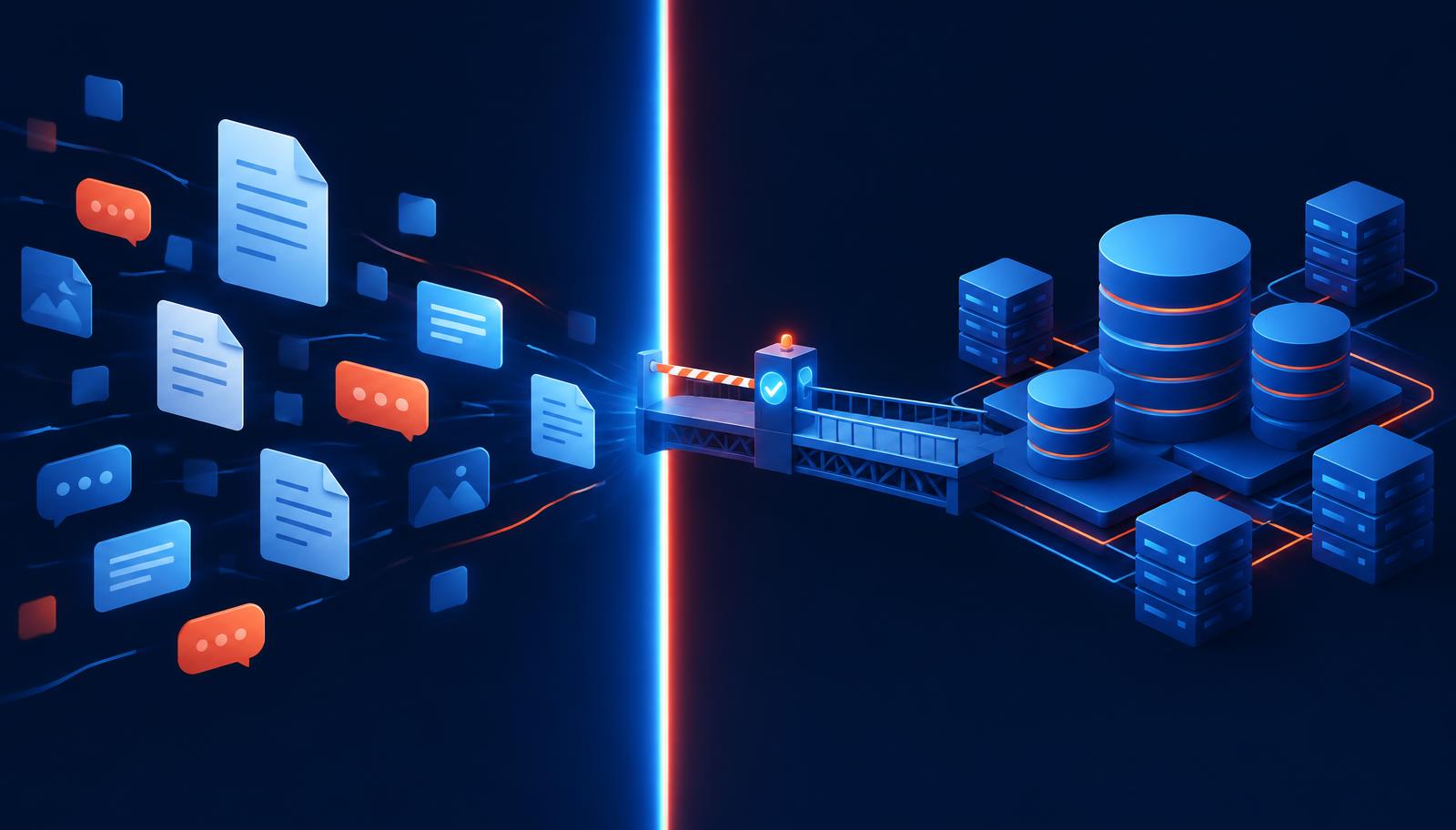
Almost every enterprise has figured out how to let AI read.
Over the past few years, companies rolled out enterprise search, copilots and chat assistants. An employee can now ask for a summary of a 60-page contract, find a policy clause in seconds, or get a first draft of a customer email. When the AI gets something wrong there, the cost is small. A summary misses a point. A draft needs an edit.
The trouble starts the moment you ask AI to write.
Not words on a screen. Writing into a system of record. Committing a purchase order in SAP. Adjusting inventory in NetSuite. Changing a pay grade in Workday. Rerouting an account in Salesforce.
That is where IT and governance teams pull the brake, and they are right to. A mistake in a draft email is a typo. A mistake in an ERP write is a compliance problem, money spent without approval, or a ledger someone has to clean up by hand.
The wall between reading and doing

Most enterprise AI lives on the left side of that wall. The systems that actually run the business live on the right. Crossing over takes more than a smarter model.
Two reasons autonomous agents stall in production
So why not connect a model to an API key and let an agent do the work? In a demo, that looks great. In production, it runs into two problems.
1. The scope problem
Most agent frameworks set limits in the prompt: "Do not approve anything over $50,000." That reads like a control. It is not. It is a request. Unusual inputs, odd document layouts or a cleverly worded email can push a model past it, and you find out after the order is placed.
A limit only holds if code enforces it outside the model. Without that, no security team should grant write access, and most do not. It is a big part of why so many agent pilots never reach production.
2. The cost problem
When an open-ended agent hits an error, it tries again. It searches again, calls another model, spins up a helper. A task that should cost cents ends up costing dollars and taking minutes. If the path and the price change on every run, finance cannot plan for it, and the budget overruns follow.
What bounded action looks like
Crossing the line means replacing open-ended autonomy with bounded execution. In VeroTX, we wrap the AI step between two layers of plain code. We call it the Sandwich Pattern.
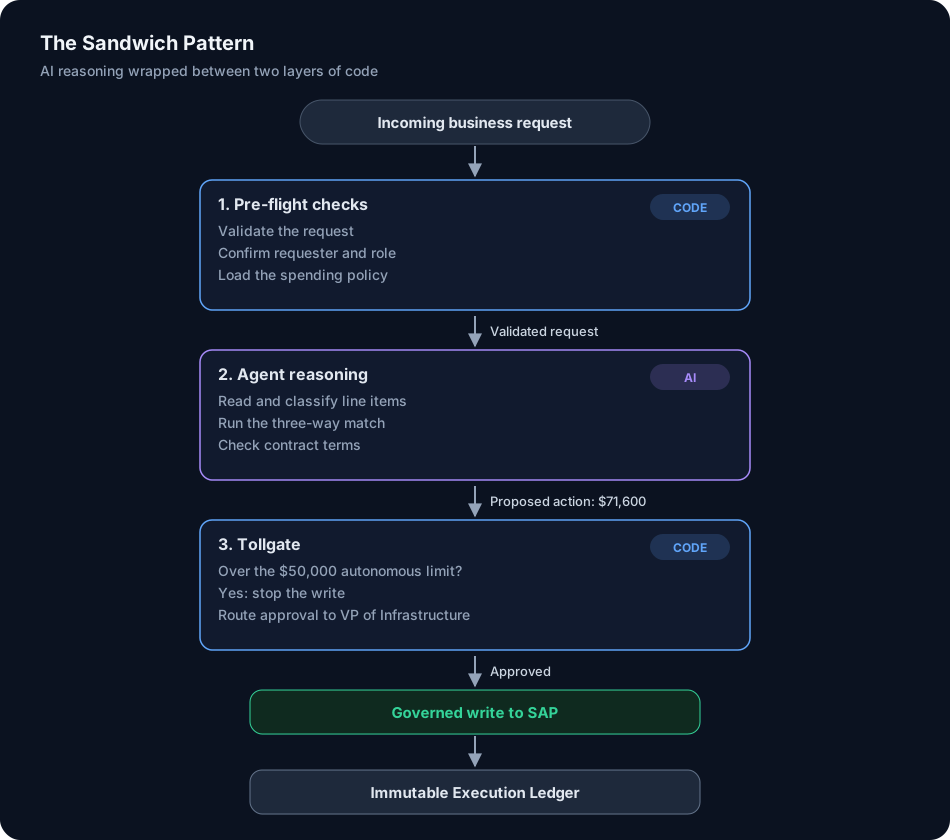
- Pre-flight checks. Before any model is called, code validates the request, confirms the requester and their permissions, and loads the policy that applies.
- Agent reasoning. The agent does what AI is good at: reading messy invoices, comparing quotes, checking a contract, reconciling inventory. Each of these is a micro-outcome, a usable business result on its own.
- Tollgate. Before anything is written to a system of record, code checks the proposed action against the rules set at design time.
A worked example
A request comes in for $71,600 of GPU server capacity. Company policy lets the platform act on its own up to $50,000.
The agent does its part well. It finds the catalog item, compares supplier pricing and confirms the contract terms. An unbounded agent might see a good discount and place the order. In VeroTX, the tollgate stops the write. The agent cannot talk its way past it. The order is staged, the VP of Infrastructure gets an approval request with the full context, and the purchase order goes into SAP only after they sign off.
Why the ledger matters
Governed execution still leaves one question: can you prove what happened? When an auditor asks why an order was placed, a chat transcript is not an answer.
Every WorkStream action in VeroTX is written to the Execution Ledger, an immutable record that captures:
- The Playbook version in force when the run started.
- Which agent and model handled each step.
- Every tollgate decision, including who approved and when.
- Every system call, with the data written to the system of record.
If a run waits four days for a supplier quote or an executive signature, it stays on the Playbook version it started on. Nobody has to guess which rules applied.
Where this fits in the enterprise AI stack

- Systems of record hold the truth: balances, employees, orders.
- Systems of intelligence help people find and understand that truth.
- Systems of action get the work done across those systems, with governed agents working inside limits you can prove.
Reading was the first chapter of enterprise AI. Doing is the next one. Until an AI system can show hard limits, code-enforced tollgates and an immutable record, it belongs in read-only mode.
Want to see the tollgate in action? Read our System of Action explainer or book a demo.
See How Procurement Eliminates Procurement Margin Leakage
Explore our execution layer for Procure-to-Pay, from intake to payment, every handoff is automated.
Explore Procurement Automation